Showing posts with label small. Show all posts
Showing posts with label small. Show all posts
Sunday, May 5, 2013
Brightness Control for small Lamps
This device was designed on request, to control the light intensity of four filament lamps (i.e. a ring illuminator) for close-up pictures with a digital camera, powered by two AA or AAA batteries. Obviously it can be used in other ways, at anyones will.
IC1 generates a 150Hz squarewave having a variable duty-cycle. When the cursor of P1 is fully rotated towards D1, the output positive pulses appearing at pin 3 of IC1 are very narrow. Lamp LP1, driven by Q1, is off as the voltage across its leads is too low. When the cursor of P1 is rotated towards R2, the output pulses increase in width, reaching their maximum amplitude when the potentiometer is rotated fully clockwise. In this way the lamp reaches its full brightness.
LP1 could be one or more 1.5V bulbs wired in parallel. Maximum total output current allowed is about 1A.
R2 limits the output voltage, measured across LP1 leads, to 1.5V. Its actual value is dependent on the total current drawn by the bulb(s) and should be set at full load in order to obtain about 1.5V across the bulb(s) leads when P1 is rotated fully clockwise.
Parts:
P1 470K Linear Potentiometer
R1 10K 1/4W Resistor
R2 47K 1/4W Resistor (See Notes)
R3 1K5 1/4W Resistor
C1 22nF 63V Polyester Capacitor
C2 100µF 25V Electrolytic Capacitor
D1,D2 1N4148 75V 150mA Diodes
IC1 7555 or TS555CN CMos Timer IC
Q1 BD681 100V 4A NPN Darlington Transistor
LP1 1.5V 200mA Bulb (See Notes)
SW1 SPST Switch
B1 3V (Two 1.5V AA or AAA cells in series, etc.)
ReadMore....
IC1 generates a 150Hz squarewave having a variable duty-cycle. When the cursor of P1 is fully rotated towards D1, the output positive pulses appearing at pin 3 of IC1 are very narrow. Lamp LP1, driven by Q1, is off as the voltage across its leads is too low. When the cursor of P1 is rotated towards R2, the output pulses increase in width, reaching their maximum amplitude when the potentiometer is rotated fully clockwise. In this way the lamp reaches its full brightness.

LP1 could be one or more 1.5V bulbs wired in parallel. Maximum total output current allowed is about 1A.
R2 limits the output voltage, measured across LP1 leads, to 1.5V. Its actual value is dependent on the total current drawn by the bulb(s) and should be set at full load in order to obtain about 1.5V across the bulb(s) leads when P1 is rotated fully clockwise.
Parts:
P1 470K Linear Potentiometer
R1 10K 1/4W Resistor
R2 47K 1/4W Resistor (See Notes)
R3 1K5 1/4W Resistor
C1 22nF 63V Polyester Capacitor
C2 100µF 25V Electrolytic Capacitor
D1,D2 1N4148 75V 150mA Diodes
IC1 7555 or TS555CN CMos Timer IC
Q1 BD681 100V 4A NPN Darlington Transistor
LP1 1.5V 200mA Bulb (See Notes)
SW1 SPST Switch
B1 3V (Two 1.5V AA or AAA cells in series, etc.)

Monday, April 8, 2013
How to Make a Small Homemade Automatic Voltage Stabilizer for TV sets and Refrigerator
A voltage stabilizer is a device which is used to sense inappropriate voltage levels and correct them to produce a reasonably stable output at the output where the load is connected.
Referring to the figure we find that the whole circuit is configured with the single op amp IC 741. It becomes the control section of the whole design.
Here we will study the design of a simple automatic mains AC voltage stabilizer which can be applied for the above purpose.
How the Circuit Functions
Referring to the figure we find that the whole circuit is configured with the single op amp IC 741. It becomes the control section of the whole design.
The IC is wired as a comparator, we all know how well this mode suits the IC 741 and other op amps. Its two inputs are suitable rigged for the said operations.
Sunday, April 7, 2013
Small Power Amplifier Circuit
Amplifier circuit is very suitable to be used or applied in a narrow space such as in cars and so forth. Voltage amplifier is needed starting from 9 Volts to 17 Volts maximum. This amplifier circuit uses IC MPC575C, andsimilarities NEC575 . Power output is relatively very small, only 2 Watts.
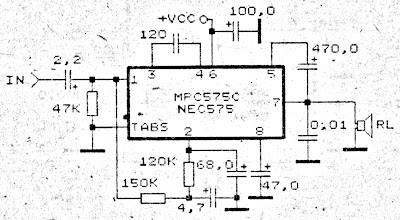 |
| Small Power Amplifier Circuit |
Subscribe to:
Posts (Atom)